
Find Who Owns Shelby Property
Each record carries its own authority. The PVA holds the searchable present-day tax-roll name, while the County Clerk keeps the instrument that actually transferred the land. Use both together, holding the parcel ID and legal description steady as names and addresses shift.
- Enter the situs address in the Shelby PVA search. Save the owner field, parcel ID, mailing address, and legal-description lead.
- Search the newest deed through the County Clerk Legal Records Division. Match the parcel and description, not merely the name.
- Read the grantee, the party receiving the land, and compare the recording date with the PVA work roll.
- If an entity owns the parcel, use the Kentucky Secretary of State to resolve the entity identity, while remembering that registration is not title proof.
Read Shelby Owner Addresses Correctly
The situs is where the parcel sits. The mailing address is where the tax notice goes. It may be a post-office box, an out-of-state office, a fiduciary, or a property manager. A vacant tract can lack a standard situs number. None of those facts alone reveals occupancy. Compare both addresses against the parcel ID. Check the abbreviated legal description too, before drawing any conclusion. When a current street fails to match an older deed, try directional terms and suffix variants. Then turn to E911 addressing and plats. County Ordinance 93 requires street-name approval before a subdivision plat reaches Triple S Planning and Zoning. So a newer street often signals a newer plat.
January 1 Can Hide a Buyer
Shelby County tax bills stay in the name of the January 1 owner. A buyer who closes later will see the former owner's name on that year's bill. The current PVA work roll may update sooner, though it can still change before certification. For present ownership, the latest recorded deed is the better confirmation. A tax-name mismatch simply prompts a comparison of dates. It also calls for a comparison of legal descriptions. Neither comparison proves either record wrong.
Confirm Shelby Ownership by Deed
The Clerk maintains legal records from 1792 to the present. Indexes for most document types generally reach 1960. Instrument images run from May 1995 forward, with selected earlier images to 1980. eCCLIX is subscription based. Its Shelby-specific result fields require a logged-in session. If the web result stops, visit or contact the Legal Records Division at 501 Washington Street, Shelbyville, 502-633-4410. Provide party names, an approximate year, the parcel, and any book/page or instrument reference. Older work may require bound books or microfilm. The Shelby County Public Library Kentucky Room and KDLA hold earlier material too. The official Clerk legal records page displays current access details. Check its live access information before requesting an instrument.
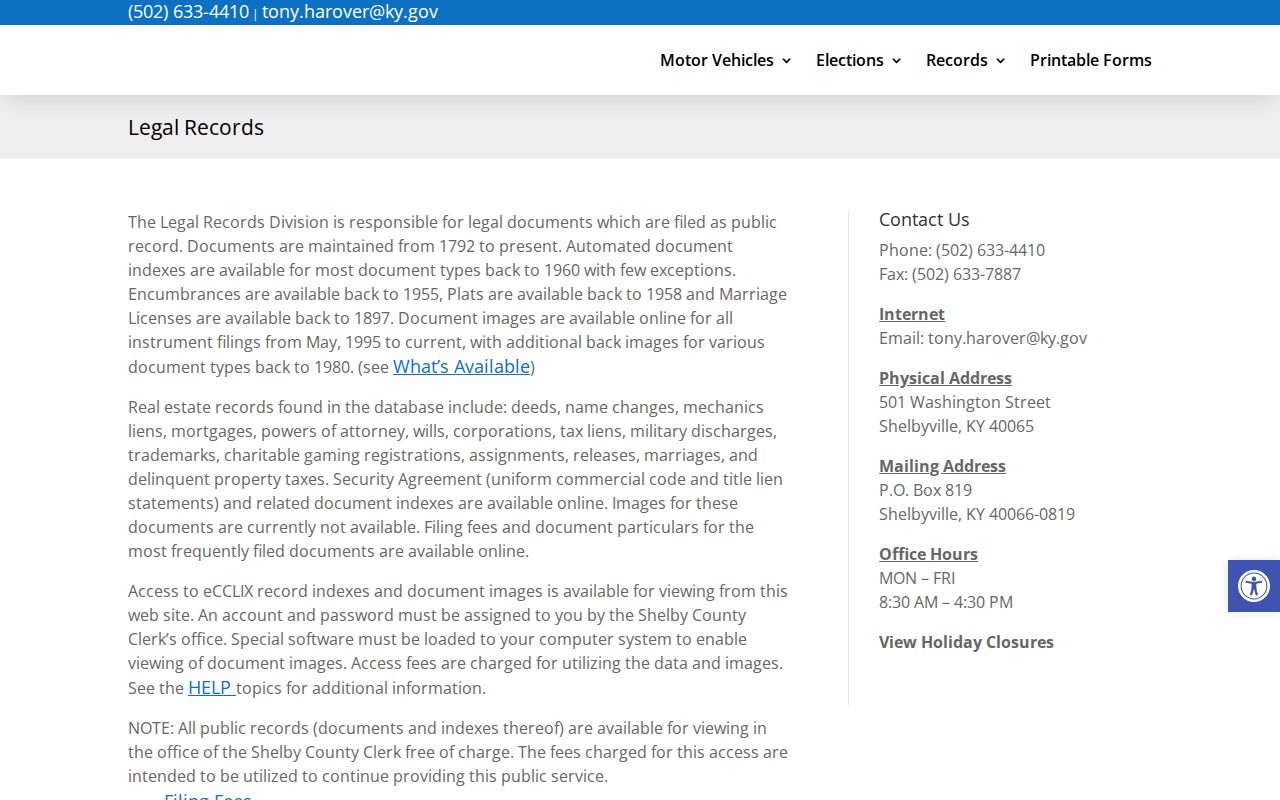
The deed copy on file with the Clerk settles who owns a parcel in Shelby County.
Entity Owners in Shelby County
The owner of record in Shelby County is not always a person. It may be an LLC, a trust, or an estate. Search the name exactly as recorded. The Kentucky business entity search returns status for an LLC or corporation. It also returns public filing details. Filters include a search-by selector, active-only choice, and advanced search. A registered agent or business address is not the parcel owner or the situs. Fix spelling and identity with the entity result. Then return to the deed. For an estate, search the local probate case along with any later fiduciary, executor, commissioner, or heir-related instrument.
Shelby County Ownership Sources
Each public source answers a narrow slice of the ownership question in Shelby County. Compare them in order.
| Where ownership appears | What it gives | How current |
|---|---|---|
| PVA work roll | Owner, mailing and situs addresses, parcel | Current work data, subject to change |
| County Clerk deed | Named grantee and transferred description | Recorded instrument date |
| Sheriff bill | January 1 billing name and tax status | Annual tax year |
| SOS entity record | Public company filing details | Entity filing status, not title |
The PVA assesses value, the Sheriff collects the tax bill, and the Clerk records each deed transfer. Permits, map polygons, and court party hits add context. None of them replaces the deed, and Shelbyville, Simpsonville, and Pleasureville keep no separate city recorders.
- Owner of record
- The name carried on an official roll or instrument.
- Grantee
- The party receiving an interest in a deed.
- Title
- The legal ownership interest, which a name result does not guarantee.
- Situs address
- The parcel's physical location, distinct from its mailing address.
Probate May Explain the Name
An estate or decedent can remain listed on the PVA tax roll for a while. Probate and recording simply take time. Kentucky eCourts can point you to a Shelby County probate case, though the District Court clerk keeps the full local file.
Look there for the will, the appointment of an executor or administrator, the inventory, and any settlement. A sale order matters too. So does any deed tied to the estate.
Then circle back to the County Clerk's deed records. A will may explain why the transfer happened, but title does not change until the proper instrument is recorded. The assessment roll only follows that step.
Correct a Shelby Owner Field
Gather your evidence before asking for a correction. Save the PVA result and the search date. Note the parcel ID, the deed reference, and the exact field in dispute. The PVA sits at 501 Washington Street, Suite 1, in Shelbyville. Its number is 502-633-4403. Ownership questions turn on the newest recorded deed, not on a simple name claim.
If an instrument is not online, the Clerk's open-record channel is the next step. A tight request names the parties, the year, and the parcel. It also gives the document type and a book/page or instrument number. The clerk's separate policy sets noncommercial copies at $0.50 per page. It allows five working days for a written response.
Limits of a Shelby Owner Lookup
A public owner of record tells you whose name sits on the deed. It does not show who lives inside. It cannot reveal an unrecorded claim or prove that title is marketable. Ownership held by an LLC or a trust is lawful. It puts an entity name into the public record. The field simply reflects what a recorded deed shows.
Kentucky Safe at Home offers eligible survivors a substitute address and confidentiality protections. The state compliance page notes a real-estate exception, though. The property address itself stays public.
For a quick present-day lookup, the Shelby County current-owner record is the right starting point. Confirm details against the recorded deed itself. A purchase or boundary dispute may call for a title professional or a licensed surveyor.
Lawful use. Shelby County owner records support due diligence, estate work, and boundary questions. Using public details to stalk, harass, or harm anyone is prohibited.