
Compare Shelby County Property Values
Kentucky law puts the PVA in charge of assessing taxable real property at one hundred percent of fair cash value each January 1. Fair cash value means what a willing buyer and seller would agree to in a normal, unforced sale. That standard sounds close to a price tag. It is not. A live offer, a lender appraisal, and an old sale amount each measure the property differently, so treat the assessment as its own number with its own meaning.
| Value | What It Is | Where |
|---|---|---|
| Assessed value | PVA fair-cash-value conclusion for the assessment date | PVA work roll |
| Market value | Expected voluntary-sale value at a point in time | Assessment method or private appraisal |
| Last sale price | Consideration reported for an earlier transfer | Deed and PVA sale history, subject to checks |
| Land and improvements | Parts that may explain the total | Parcel card labels, when displayed |
Shelby assesses at full fair cash value rather than a fractional ratio. Yet the approach is mass appraisal: common methods applied across thousands of parcels at once. A private appraisal works the other way. It studies one property for one date and one purpose. The most recent sale price can mislead too. It may be stale, non-arm's-length, or bundled with several parcels. The Shelby PVA search screen shows the starting lookup fields on the official page.
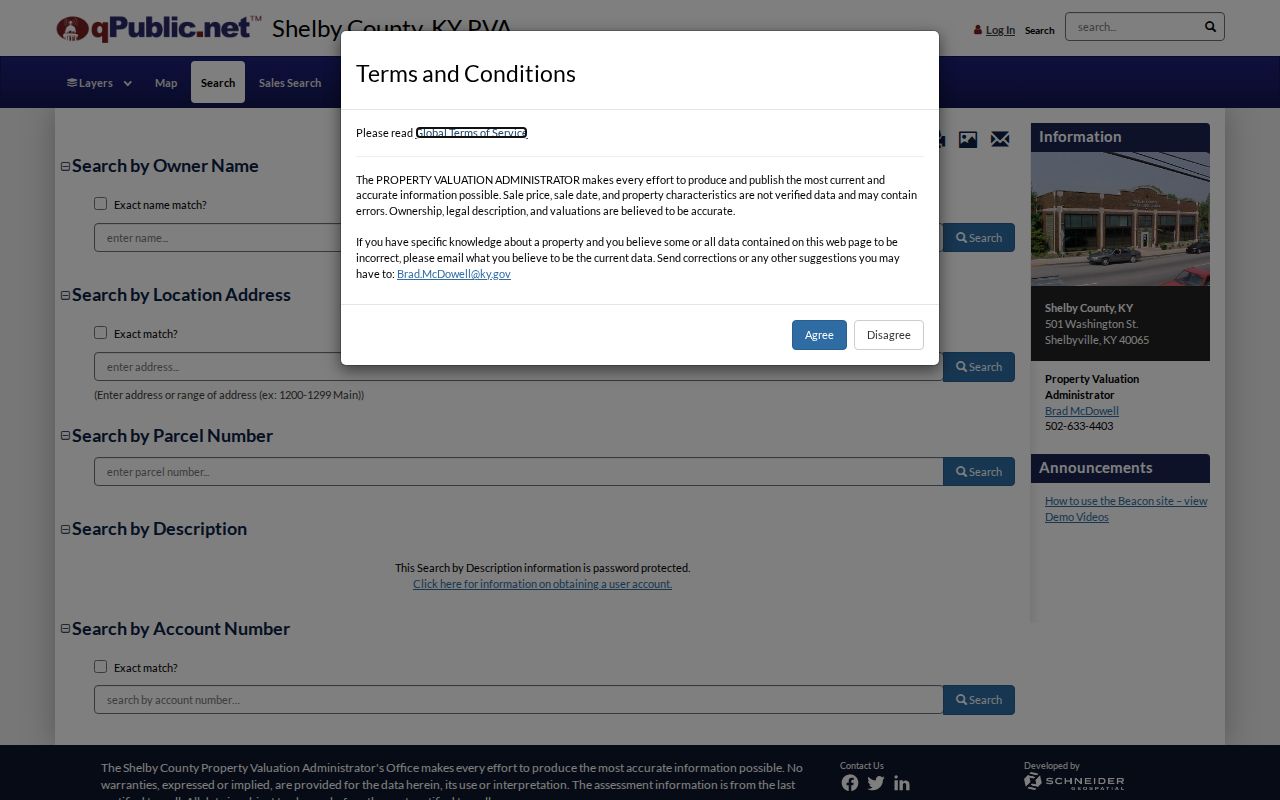
Verify the parcel before reading any value shown in the result.
Shelby PVA Holds Value Records
The Shelby PVA search takes an owner name, location address, parcel number, or account number. A description search needs an account first. On its working roll the PVA tracks ownership changes, tax maps, building details, and exemptions. Certification can shift results. The PVA also warns about sale prices, sale dates, and property characteristics. Those details may not be verified. Note the year and the parcel number. Check the field labels too, instead of copying one bare total.
Look Up Shelby Assessed Value
Start with the situs address. When spelling or a road change defeats the search, fall back on the owner name or the parcel and account numbers. Keep the mailing address out of the hunt, because it often points somewhere other than the property.
- Search by location address and select the matching parcel.
- Confirm parcel ID, legal-description clues, and assessment year.
- Read the total and any land, improvement, exemption, or sale fields.
- Verify a sale amount in the deed when it affects the conclusion.
- Assessed value
- The PVA's value conclusion used in taxation.
- Fair cash value
- Kentucky's willing-buyer, willing-seller measure.
- Reassessment
- A later review that may change roll value.
- Consideration
- Value stated for a transfer, which may not equal market price.
January 1 Sets Shelby Value
January 1 fixes the assessment date. It also sets the key ownership date for the whole tax year. New construction gets picked up annually. State guidance calls for a physical inspection of each parcel. Each one must be checked at least once every four years. A figure shown months later still belongs to that January framework. A sale after that date can leave the tax bill under the old owner's name. That proves nothing about current ownership. Nor does the sale price become the new assessment. Pair every number with its date.
How Shelby Values Are Estimated
Kentucky guidance lets PVAs lean on sales comparison, cost, and income approaches. Sales comparison weighs the most relevant transfers. Cost totals land plus improvements and subtracts lost value. Income fits land bought mainly for what it earns. Which method dominates depends on the property and the proof available. No mass appraisal can match an on-site one. The PVA's building characteristics may back a figure, but the office cautions that those facts are not verified for other uses. Report any error straight to the PVA.
Shelby Sale Data Needs Checks
The recorded deed is the true source for any transfer. The PVA sometimes lists a sale date and price, but flags both as unverified. Family deals can distort a sale figure. Gifts, estate transfers, and multi-parcel deeds can too. Any of these can make an amount useless as a comparable. Go to the Clerk's instrument for the parties, deed type, consideration, and land description. A recording fee is not a purchase price. It just pays for filing the paper. Note: Keep the transfer date beside the assessment year. A later sale never rewrites an earlier January 1 valuation.
Agricultural Shelby Value Differs
Agricultural classification is its own question. Kentucky and the Shelby PVA both publish application guidance. A qualifying use-value figure can sit far below fair cash value. Acreage, a barn, or a rural address alone proves nothing. Read the parcel card's labels. Then ask the PVA about current rules. Exemptions change taxable treatment, never a buyer's likely price. Bill and appeal details live with Shelby County property tax records.
City Rates Are Not Values
The official 2025 rate book sets separate real-property rates for Shelbyville, Simpsonville, and Pleasureville. Those cents-per-$100 numbers are rates, not values. They apply to an assessed base. County, school, and special-district rates can stack on top. Historic overlays and development approvals add context too, but they do not hand anyone a dollar figure, so resist reading a value trend into an annexation or a permit.
Check a Shelby Value Change
An increase notice opens with a PVA conference and then a Board of Assessment Appeals filing. The calendar allows a thirteen-day roll inspection period starting the first Monday in May, unless extended, followed by the board window. Confirm the current dates and forms first. Bring the parcel card, factual corrections, comparable sales, photos, and proof tied to the valuation date. A rate complaint goes elsewhere. The PVA sets no rates and collects no bills.
Read Shelby Value Evidence Together
Three dates anchor any honest value review in Shelby County. The assessment date falls on January 1. The deed carries its own transfer date. Any inspection or improvement adds a third. Keep them labeled. A summer transfer may already appear in the deed history. The tax bill may still name the January owner of record. A later portal update changes none of that, so never treat these dates as interchangeable.
Property characteristics need the same discipline. Square footage, construction type, use, and improvement data may guide mass appraisal. Yet the PVA itself tells users to verify those details before relying on them. When one feature drives your conclusion, set the parcel card beside permits, plans, a site visit, and other direct proof. Fixing a factual error is also a different task from arguing the valuation method missed fair cash value.
Neighborhood sales only help when they truly compare. Confirm the deed covers the same parcel count, property type, and interest conveyed. Family transfers, estate instruments, gifts, and bundled tracts may not reflect an open-market bargain at all. Kentucky's willing-buyer and willing-seller standard supplies the test. Not every number in a sale-history field counts as equal evidence.
City boundaries impose their own limits. A city tax rate can apply after annexation. But a rate multiplies the assessed base rather than creating it. Shelbyville's historic overlay or Simpsonville's development approvals may shape how a buyer sees land. Yet those records offer no official price trend. Tie every claim about change to an actual assessment year or a verified sale.
What Shelby Property Value Cannot Prove
An assessed value cannot prove a sale price, a property's condition, title quality, boundary location, or future demand. It is one official assessment figure. Verify characteristics with the PVA, transfers with the Clerk, and physical lines with a survey.
A current independent appraisal fits when a sale, loan, estate, or dispute needs a supported opinion. That opinion is tied to a set date. Even that appraisal cannot replace a deed search or a full title search.
Value vs price. A Shelby County assessed value is not a guaranteed sale price. Obtain a qualified appraisal when a transaction needs a current opinion.