
Inside Shelby County Tax Records
Shelby County property tax records are divided between the Property Valuation Administrator and Sheriff. The PVA determines fair cash value as of January 1, maintains parcel and building facts, applies approved exemptions, and prepares the assessment roll. The Sheriff collects current taxes. The County Clerk later handles delinquent tax certificates. These roles matter because no single screen proves value, ownership, and payment status at once.
| Field | What It Shows | Where |
|---|---|---|
| Fair cash value | PVA value conclusion as of January 1 | PVA work roll |
| Owner and parcel | Tax-roll name, situs, mailing address, and parcel ID | PVA property search |
| Exemptions | Approved relief affecting taxable value | PVA record and forms |
| Tax bill and balance | Current charge, payment, penalty, or delinquency | Shelby County Sheriff |
| Delinquent certificate | Certificate and electronic tax-sale information | Shelby County Clerk |
Kentucky assesses taxable real estate at fair cash value. The statutory standard is 100 percent of that value, which makes the assessment an official number rather than a private appraisal or a purchase offer. A Shelby County bill stacks state, county, school, city, and special-district rates on the taxable base. The last sale price is different. It is a transfer fact. Check it against the recorded deed, since the PVA warns that its sale dates, prices, and property characteristics may not be verified.
Search Shelby County Assessments
The free Shelby County PVA and Schneider Beacon search is the first stop on the assessment side of property records. It uses separate panels. There is no single broad box. Begin with a clean street name and save the exact parcel number for later checks. A description search needs an account.
| Search field | Input | Useful detail |
|---|---|---|
| Owner | Name | Exact-match option helps with common names |
| Location address | Exact address or range | Autocomplete can show up to ten choices |
| Parcel number | Recorded identifier | Best after a bill, deed, or map result |
| Account number | PVA account | Direct route to the work-roll entry |
The work roll can change before certification. Confirm any disputed field with the PVA, whose search information page posts the public-data limits.
Open the live Beacon search to run the lookup.
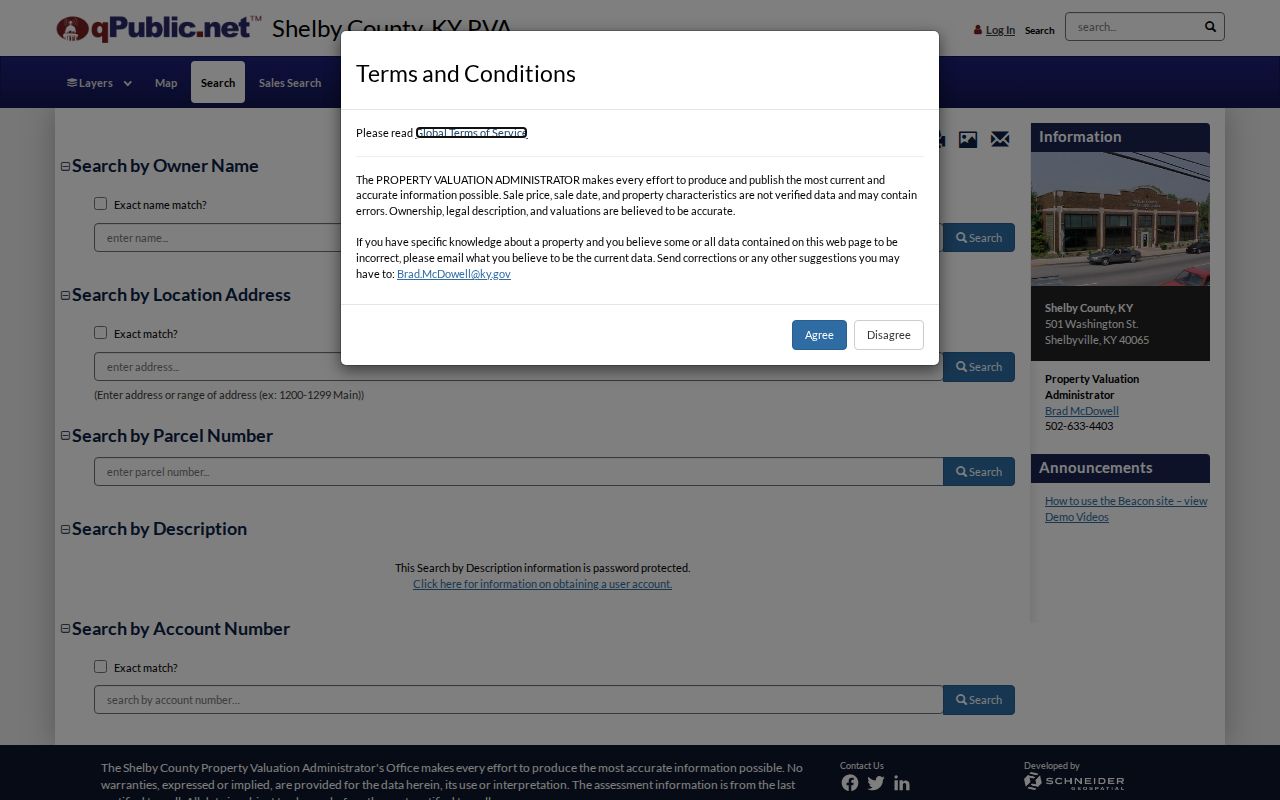
The official Beacon entry screen shows the search modes. Live parcel data controls every result.
Shelby County Tax Bill Steps
Assessment and collection are linked. The offices do different work, so following one order keeps the parcel, value, and balance tied to the same piece of real estate.
- Find the address in the PVA search and copy the parcel ID, owner field, and assessed value.
- Open the Shelby County Sheriff tax route and locate the current bill. If the online route fails, call 502-633-4324.
- Compare the taxing districts and owner name with the PVA entry. A January 1 name can remain on the bill after a later sale.
- Check the Clerk only when the account is delinquent or a tax certificate may exist.
- Assessed value
- The PVA's fair-cash-value conclusion for tax administration.
- Tax rate
- The levy stated in cents per $100 of assessed value.
- Homestead exemption
- Approved relief for a qualifying owner age 65 or older or a qualifying totally disabled person.
- Tax lien
- A public claim tied to unpaid tax, not proof that title has changed.
Note: The Sheriff collects Shelby County property tax, while the Fiscal Court Treasurer manages county finances but has no collection role.
January 1 Controls the Tax Name
The annual ownership snapshot is one of Shelby County's most useful tax quirks. The bill stays in the name of whoever owned the parcel on January 1. A deed that closes later changes little in the short term. The purchaser may see the former owner's name through that entire tax year, even while the PVA begins processing the ownership change on its side.
That mismatch alone does not make either record wrong. Look at the current PVA work roll first. Then read the latest recorded instrument through the County Clerk, where the deed date and legal description help separate a routine update lag from a true parcel or party mismatch.
Recent sale. A recorded deed can be newer than both the annual bill and a changing work roll. Verify the same parcel and legal description.
Shelby Tax Rates Stack
The 2025 Kentucky Property Tax Rate Book shows why one county rate cannot predict a full bill. The countywide real-estate rate is 20.3500 cents per $100. The general county school rate is 71.4 cents. City rates add more: 24.7 cents in Shelbyville, 8.9 cents in Simpsonville, and 14.9 cents in Pleasureville.
Special-district lines may also apply. The book lists fire, watershed, and other districts, including mergers that changed older district names. Match the lines on the actual bill. Never add every rate listed for the county, and remember that rates change by year, so use the book for the bill year being studied.
Shelby County Exemption Records
Exemptions run through the PVA. The PVA takes applications and marks approved relief on the assessment roll. Its exemption guidance covers homestead and disability qualifications, agricultural use, and other classifications. Eligibility is not automatic. The current form and supporting proof must reach the office. Then review the parcel card. The bill may lag, since roll certification and billing follow a fixed calendar. Disability reapplication runs December 1 through December 31. Send qualification questions to the PVA at 501 Washington Street, Suite 1, Shelbyville. Do not send them to the Sheriff.
Review the current PVA exemption page before choosing a form.
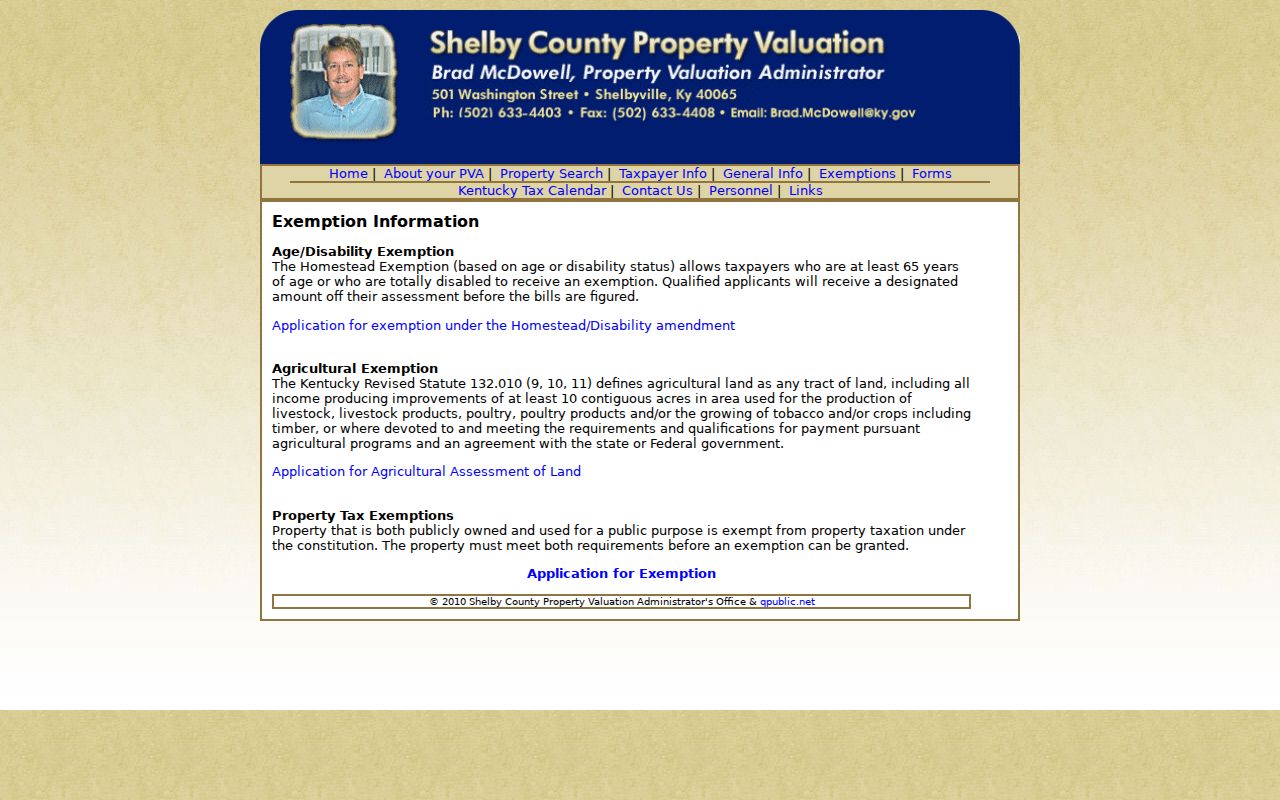
The official exemption page anchors the application route, and PVA staff determine qualification under current rules.
Open Shelby County PVA forms for the current application.
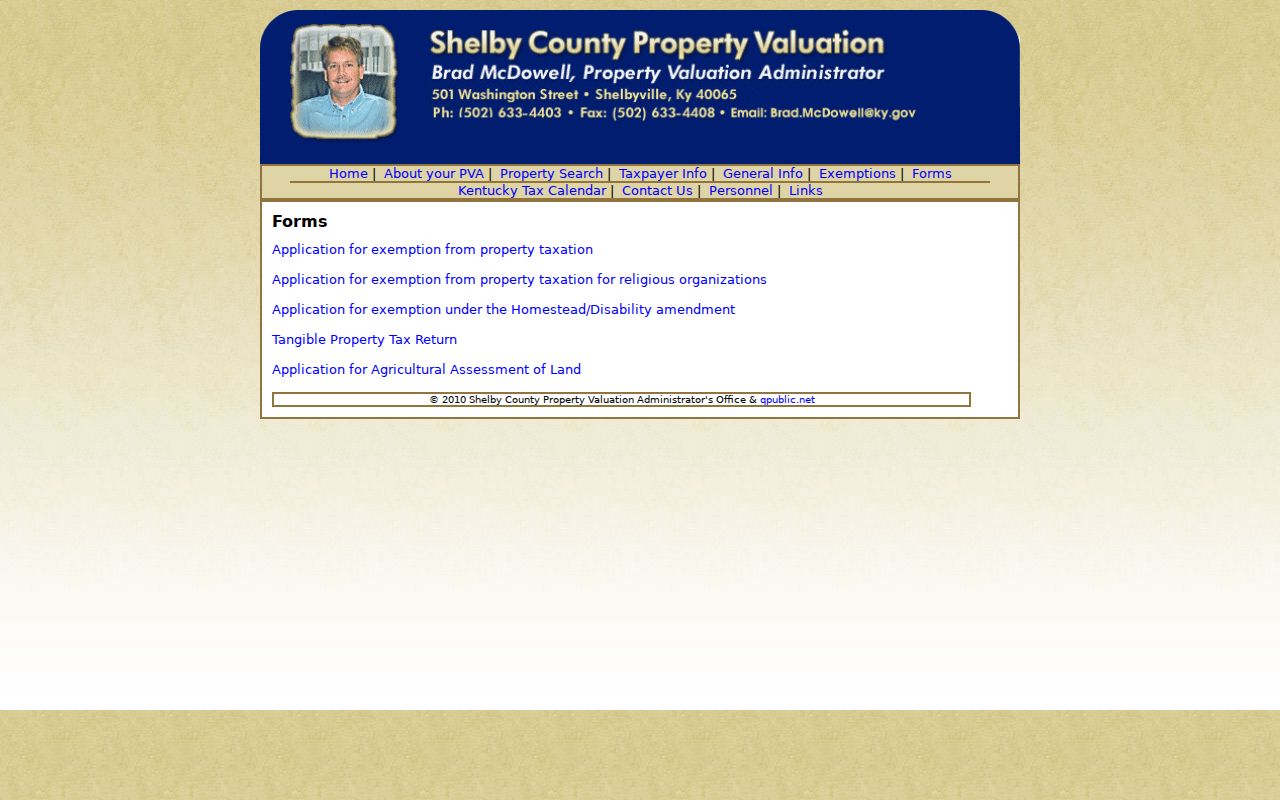
The forms page is the official document source. Confirm the chosen form and filing date directly with the PVA.
Shelby Payment Calendar
The Shelby PVA calendar puts every assessment and collection milestone into one sequence. Real estate is assessed January 1. Listing then runs through March 1. The tax roll opens for inspection on the first Monday in May and remains open 13 days, six days a week including Saturday, unless the period is extended. Payment terms reward early action. A bill paid by November 1 gets a discount.
Face value holds from November 2 through December 31, after which the bill becomes delinquent on January 1. A 5 percent penalty applies through January 31. After that date, a 10 percent penalty and a 10 percent Sheriff's fee stack onto the balance. The listed tax-claim sale date is April 30, though the Clerk publishes the operational sale schedule, so consult the live Shelby PVA calendar before acting.
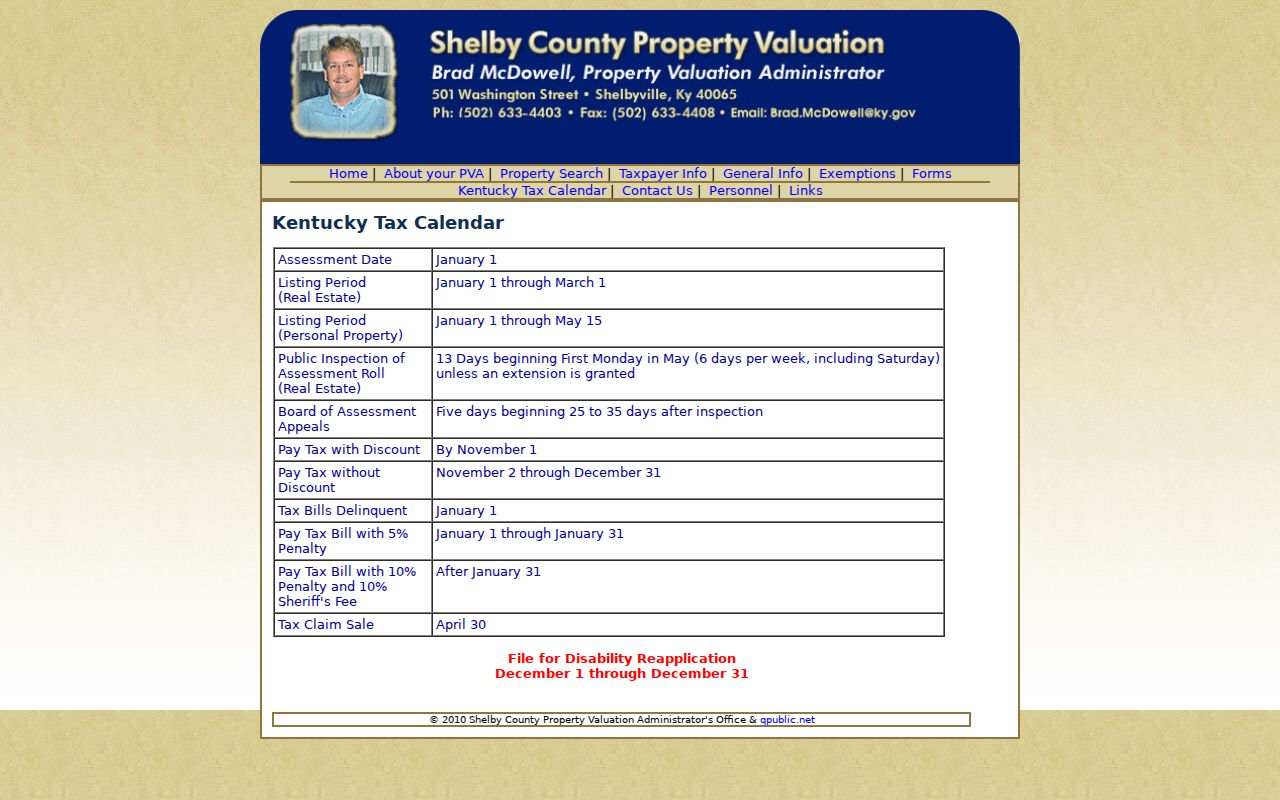
The calendar sets the timing; later office notices control any change.
Shelby Delinquent Tax Certificates
The County Clerk's delinquent-tax page describes the 2026 certificate sale. The sale is electronic, not in person. It is scheduled for September 2 at 10:00 a.m. Listed submissions are due August 20. Purchasers must register, pay a $30 filing fee per certificate, and, if they are non-prior buyers, post a 25 percent deposit based on list value.
A certificate is not clear title. Bankruptcy, redemption, notice, assignments, and later court or deed filings can all change the trail of ownership. One paragraph on the Clerk's page names the Bullitt County Clerk, which reads as a publication error. Treat it as an error until the Clerk confirms. The page also displays the published Shelby County route, and you can open the Clerk's live delinquent-tax instructions before relying on any date.
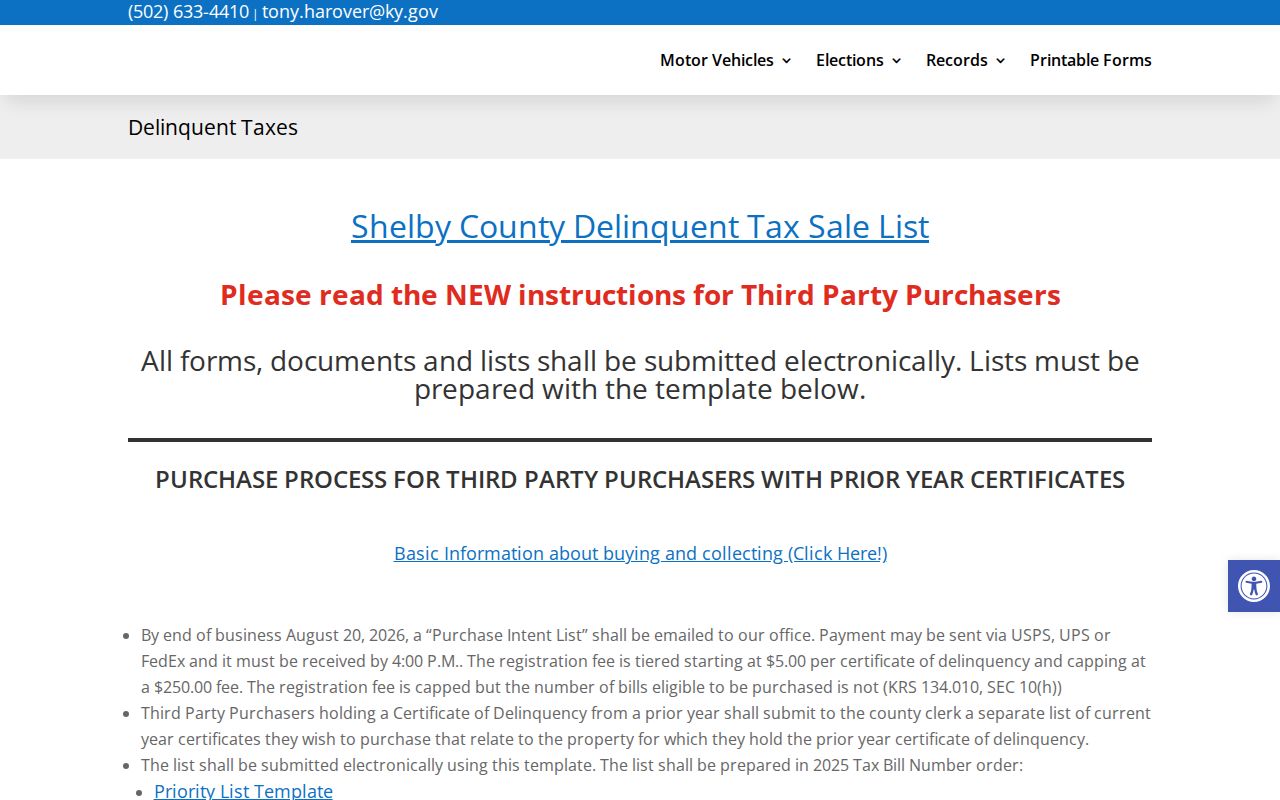
The capture identifies the right source, while the live page controls updates and corrections.
Read a Shelby County Tax Bill
A tax bill answers a collection question, not every property question. Check the parcel number. Then confirm the tax year, the assessed base, district lines, the owner used for billing, and payment status. Compare city boundaries and special-district coverage first. Only then dispute the arithmetic. A wrong value goes to the PVA. The Kentucky Department of Revenue property-tax overview explains how the statewide property tax structure works. In Shelby County, the PVA maintains the local assessment, the Sheriff confirms the amount collected, and copies of both records smooth any reconciliation with either office.
Contest a Shelby County Assessment
Start a value appeal by talking with the PVA. Strong evidence matters. A recent arm's-length sale, comparable sales, photographs, measurements, repair facts, or an appraisal aimed at the valuation date can all support the case. The public inspection period opens the first Monday in May. The Board of Assessment Appeals then meets for five days beginning 25 to 35 days after inspection closes.
Confirm the current filing form and deadline each year. The PVA forms page and the office at 501 Washington Street, Suite 1 are the right starting points. A value challenge is one thing. Correcting a name, address, or building fact is a separate request.
Appeal window. Inspect the Shelby roll in May and confirm the current conference and Board filing dates with the PVA before the short period closes.