
Trace Shelby County Former Owners
Start with the newest recorded instrument tied to the parcel. The Shelby County Clerk keeps legal records from 1792 forward, though online depth differs by record type. Most automated indexes reach back to about 1960. Encumbrance coverage stops at 1955, plats at 1958, and instrument images open in May 1995, with some back images to 1980. Treat these as coverage guides. No cutoff promises that every page is online.
| Source | Years It Covers | Where Held | What It Shows |
|---|---|---|---|
| Clerk legal-record index | Mostly 1960 to present | Clerk and eCCLIX | Parties, instrument references, and transfer sequence |
| Online instrument images | May 1995 to present, plus selected older images | eCCLIX subscription | Recorded deed text and legal description |
| Kentucky Room deed microfilm | 1792 to 1878 | Shelby County Public Library | Early deeds and named parties |
| Plats and tax lists | Varies by series | Clerk, library, and archives | Lot identity and year-by-year ownership clues |
A recent transfer calls for the current owner and parcel card. That pins down the latest deed. A nineteenth-century question works the other way. Begin with a known later deed or a tax-list name. Then move into the library and clerk holdings. A name alone proves little. Match acreage, adjoining owners, watercourses, roads, lot numbers, and prior deed references. Only then call two entries the same tract. The Shelby Clerk legal-record overview is the official screen for coverage and access.
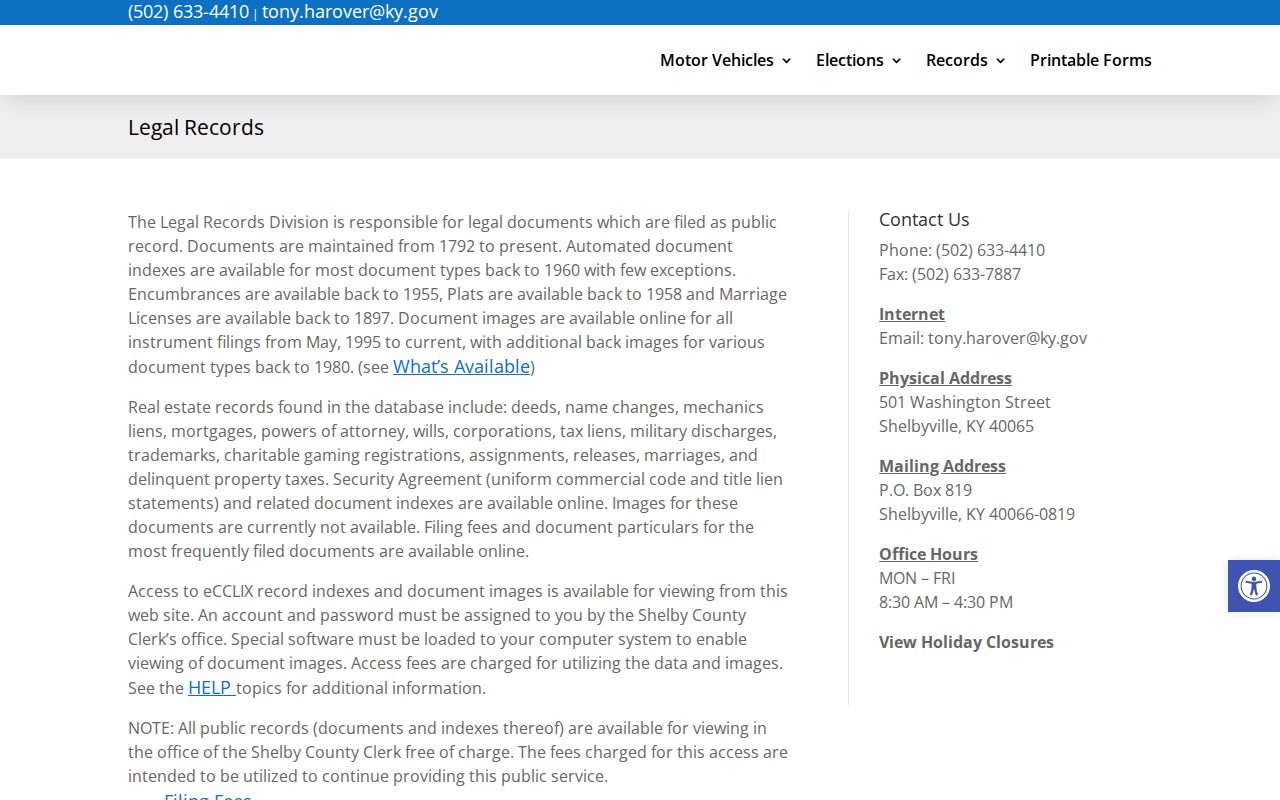
Its dates separate an index hit from a deed image you can open online.
Shelby Deed Coverage Changes by Era
The Clerk's legal-records page distinguishes index coverage from image coverage. An index entry may identify a deed whose scanned pages are not online. A paid eCCLIX account is the online route. The clerk counter remains the practical fallback for books, indexes, and copies. The office sits at 501 Washington Street in Shelbyville. It takes inquiries by phone, mail, fax, and email.
Do not force one cutoff date across the whole chain. A 1988 deed may carry an added back image. Another filing class may offer only an index entry. Record the instrument type, party names, recording date, and book/page before leaving any result. Those facts let staff pull the page. They also let the next search move backward with less risk of a same-name error.
Shelby County's Backward Deed Method
A backward chain treats each deed as proof and pointer at once. The present owner of record acquired the parcel by a deed. That deed names the seller, called the grantor. Search that grantor as a buyer, or grantee. That search locates the deed by which the seller took the same land. Then repeat the step. Kentucky archival guidance favors grantor and grantee indexes. Old deeds often lack a modern street address.
- Find the current parcel in the PVA search and record the owner name, parcel number, and legal-description clues.
- Locate that owner's acquisition deed and transcribe its grantor, date, deed type, and book/page.
- Search the grantor as grantee, then compare the land description and prior citation.
- Repeat until the automated index ends, then continue in reverse indexes and deed books.
- Grantor
- The person or entity conveying an interest.
- Grantee
- The person or entity receiving that interest.
- Chain of title
- The linked sequence of instruments affecting the same land.
- Reverse index
- An index arranged by grantee rather than grantor.
Prior References Keep Shelby Land Aligned
Older deeds often cite the earlier deed book and page. That citation is the cleanest bridge to the next former owner. If it is missing, compare the full legal description, not just acreage. A tract may have been split, combined, or conveyed with an exception. A quitclaim deed releases an uncertain interest, while a warranty deed carries promises about title. Neither label alone proves the chain complete.
Modern parcel IDs are assessment keys, not timeless title identifiers. The county format can include map, block, parcel, and subparcel segments, yet historic books may describe a farm, creek, road, neighbor, or survey line. Keep both systems in your notes. The legal description holds continuity when a road changes name or a subdivision creates new lots on the plat.
Shelby Probate Can Break the Pattern
Not every ownership change looks like a sale. A will, affidavit of descent, commissioner's deed, partition case, or court order may explain the change. That is often why an heir appears next in the property records. The Clerk records wills and descent affidavits among its legal records. A full probate or civil file may sit with the circuit clerk. If the deed trail jumps, search the decedent first. Then search the heirs. Also search the estate representative.
The deed index still anchors the land history. Court papers explain authority and shares. The recorded deed shows what actually reached the public land record. Names carrying index clues for heirs, commissioners, or sheriffs deserve a second search. Check probate sources and court sources.
Historic Shelby Deeds Leave Online
The Kentucky Room holds Shelby deed microfilm for 1792 through 1878, plus tax lists, wills, order books, marriages, newspapers, and genealogy tools. It is a strong bridge when former owners predate the clerk's automated index. Tax lists can place a name with land in a given year. They are leads, not title proof. Confirm each lead in a deed book or court record.
Kentucky Department for Libraries and Archives research guides explain how grantor-grantee indexes and microfilm work. FamilySearch collections may make some deed images easier to browse. Neither replaces the county's recorded copy. Cite the repository, book, page, parties, and date so another person can reproduce the step.
Note: The library's property-history sources reach well beyond deed film, including local newspapers spanning much of the nineteenth and twentieth centuries.
Plats Test Shelby Former Owners
A plat settles arguments that deeds alone cannot. If two deeds seem to describe the same lot, the plat shows whether they truly do. Shelby plats are indexed back to 1958. Recorded restrictions may name the subdivision, section, phase, lot, or developer, and those identifiers should be checked against the deed and the parcel card. A neighboring lot with a similar address is not the subject parcel just because its owner of record sits on the same street.
Rural land takes a different eye. Read the calls to roads, water, adjoining owners, and acreage. E-911 street-name approval comes before a subdivision plat reaches planning and zoning, so a new street can signal a later plat even when the parent deed still uses a farm or route description. That local sequence is why address-only searching can miss past owners of the parcel.
Check Shelby Chain Gaps Carefully
Build a simple chronology with one row per transfer. List the date, grantor, grantee, deed type, and book and page. Add a short note matching the land. A gap shows up when an owner conveys property. It means no acquisition deed appears behind it. Before assuming a record is missing, search spelling variants, initials, spouses, trusts, corporations, and estate names. A patient Shelby County property search often closes what looks like a hole.
| Transfer date | Grantor to grantee | Deed type | Book/page |
|---|---|---|---|
| Newest | Current deed parties | As recorded | Copy exactly |
| Prior | Prior owner to later owner | As recorded | Follow cited source |
| Earlier | Book-index parties | As recorded | Clerk or microfilm |
Treat the table as a method, not a sample Shelby title report. Fill it only from the actual instruments. For a recorded copy, use the Shelby County deed records route, since the former-owner task is the linked sequence rather than one isolated page.
Read a Shelby Chain Backward
At every step, confirm the land conveyed is still the land under study. A former owner may have held several Shelby County parcels. One deed may convey only part of a tract. Write down exceptions, reservations, easements, and prior references. Also search both spouses and entity names whenever they appear.
The PVA current work roll gives a useful starting owner. But it can shift before certification. A tax bill is weaker still. It stays in the name of whoever owned the parcel on January 1. Begin with the parcel card instead. Then confirm any recent transfer in the recorded deed. After that, walk the chain backward through the deed records.
Shelby Sources for Difficult Chains
A hard chain deserves wider care. The Kentucky Room holds marriages, wills, order books, tax lists, newspapers, and vertical files alongside its deed microfilm. A marriage record can explain a surname change. A will can identify heirs. An order book can point to a commissioner's sale or partition, and a newspaper can supply a date or an estate notice. None of these conveys the land by itself. Each can still lead back to the recorded instrument that does.
The Kentucky Department for Libraries and Archives holds research guides and Shelby court inventories. Historical court indexes help when a deed names a commissioner, sheriff, estate, or suit. Search the same surname within the relevant date band. Then request the actual file or order. Never infer a result from an index caption, because a case file may concern several tracts and the recorded land instrument remains the key link.
Business names demand exact handling too. A corporation, trust, or partnership may acquire land, change its name, or dissolve. Search the Kentucky Secretary of State business record for name variants and dates, then return to the grantor-grantee index. A UCC filing can cover fixtures or equipment, but it is not the county deed index and never belongs in an ownership chain as though it transferred real estate.
Spelling matters as much as names. Handwritten books, initials, suffixes, married names, and indexing conventions can all hide the same person. Search reasonable variants without collapsing distinct people. The land description is the real test. Acreage, road calls, adjoining owners, lot numbers, and prior citations should line up through each former-owner step.
How Far Shelby Ownership Goes
Shelby County's maintained legal-record history reaches back to 1792. The practical route shifts from current PVA data and eCCLIX indexes. It turns toward clerk books, library microfilm, tax lists, and archival court material. Early land may lead to a patent or a parent tract. An estate division or a county-boundary question may also surface. Stop only when the evidence stops supporting the link, not when the web portal ends.
Former-owner work is historical research, not a title opinion. Missing heirs, unrecorded interests, name changes, and boundary disputes can all matter. Instruments indexed under unexpected parties can matter too. Legal rights may depend on a complete chain. Then a professional title examination is the right step.
Lawful use. Research former owners for house history and property diligence. Never use names or addresses to track, intimidate, or harm a person.